
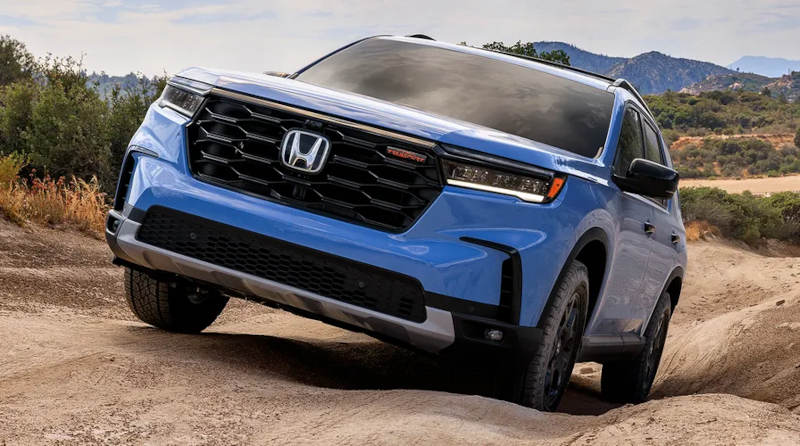
When Honda revealed the fourth-generation Pilot, the headlines went straight to the new TrailSport trim: a bigger, squarer, genuinely more capable three-row SUV aimed at families who want to leave the pavement occasionally. It is a strong vehicle. But if you found this page because you buy vehicles for resale in another market, you need a different conversation than the one the American motoring press is having. You need to know whether this truck fits your channel at all — and that answer is not the one most spec sheets will give you.
Here is the honest version, from people who move used vehicles across borders for a living.
The short answer first
The 2023 Pilot TrailSport is a North American vehicle. It is built at Honda's plant in Lincoln, Alabama, sold in left-hand drive, and it was never offered on the Japanese domestic market. That single fact reshapes everything about sourcing, pricing, and compliance for an importer — and it is the detail that gets buried when a review focuses only on trail modes and cup holders.
If you operate in a left-hand-drive market, the Pilot can be a sensible import from North American or Gulf re-export channels. If you operate in a right-hand-drive market — Japan, the UK, Australia, Kenya, Tanzania, Pakistan, and much of the Caribbean and Southern Africa — the Pilot is almost certainly the wrong vehicle to chase, and we will explain what to source instead.
What the 2023 Pilot TrailSport actually offers
Taken on its own merits, the redesign is a real step up. The TrailSport is no longer a cosmetic package; for this generation it earned actual off-road hardware.
Specification
2023 Pilot TrailSport
Engine
3.5 L naturally aspirated V6 (DOHC)
Output
285 hp; 262 lb-ft (≈355 Nm) torque
Transmission
10-speed automatic
Drivetrain
Standard AWD (2nd-gen i-VTM4 torque vectoring)
Ground clearance
≈8.3 in (211 mm) — roughly an inch over other trims
Tyres
265/60R18 all-terrain (factory-fitted)
Protection
Steel skid plates (oil pan, transmission, fuel tank)
Recovery
Rated front and rear recovery points; full-size spare
Towing
Up to ≈5,000 lb (≈2,268 kg), AWD
Seating
Three rows, 7–8 passengers
Fuel economy
≈20 mpg combined (≈11.8 L/100 km)
The mechanical highlight is the i-VTM4 all-wheel-drive system, which can send a large share of torque rearward and then shuffle it left-to-right across the rear axle. It is closely related to the system Acura markets as SH-AWD, and it makes the Pilot more composed on loose surfaces than most unibody rivals. Add the factory lift, all-terrain rubber, skid plates and a Trail drive mode with a dedicated camera view, and the TrailSport becomes a credible light-duty overlander rather than a badge exercise.
For a family buyer in the United States, that is a compelling package. For an importer, specifications are only half the decision.
Why you won't find it in the Japanese export channel
Japanese Auto World exists to connect buyers with verified exporters of used Japanese-market vehicles. The Pilot does not travel through that channel, and it is worth understanding why, because the reasoning applies to a whole category of vehicles buyers mistakenly search for in Japan.
Japan's enormous used-vehicle export supply is built almost entirely from cars that were originally sold new in Japan. Those cars are right-hand drive, maintained to Japan's strict shaken inspection regime, and turned over quickly because of that same regime — which is exactly why they represent such good value abroad. The Pilot was never part of that pool. It was not sold new in Japan, so there is no domestic used stock of it to export. Any left-hand-drive Pilot you see advertised as "from Japan" is either a mislabelled re-export or a listing to treat with caution.
This is the kind of distinction a neutral directory is built to protect you from. A dealer with skin in the game has an incentive to sell you whatever is on the lot; a directory's only job is to point you to the right source for the right vehicle.
The question that actually decides it: LHD or RHD
Before the specs, before the price, before the shipping quote, one question settles whether the Pilot belongs in your plan at all: does your destination market drive on the left or the right?
- Left-hand-drive markets (much of the Middle East, Central Asia, West and Central Africa, Central and South America): a used Pilot can make sense, sourced from North American auctions or Gulf re-exporters. Confirm your country's maximum vehicle age limit and emissions rules before committing.
- Right-hand-drive markets (Japan-sourcing buyers, the UK, Ireland, Australia, New Zealand, Kenya, Tanzania, Uganda, Pakistan, much of the Caribbean, Southern Africa): a left-hand-drive Pilot will usually fail registration or face punitive conversion costs. This is where importers lose money — buying a vehicle that cannot be legally or economically registered on arrival.
If your market is right-hand drive, stop looking at the Pilot and look at what Japan actually exports.
The right-hand-drive alternative: what Japan offers instead
Buyers who want a spacious, reliable Honda for a right-hand-drive market are far better served by the Japanese used-export market's genuine strengths:
- Honda CR-V — the natural SUV alternative: proven, plentiful in Japanese stock, and RHD.
- Honda Vezel / HR-V — a compact crossover with strong resale demand across Africa and South Asia.
- Honda Stepwgn, Freed and the JDM Odyssey — if the real requirement is three rows and interior space rather than off-road capability, Japan's minivans deliver more room per dollar than any imported Pilot.
For most families in RHD markets, one of these will out-value a converted or grey-import Pilot every time — with a compliant, insurable, resaleable result at the end.
Import compliance: the checklist that protects your margin
Whatever vehicle you land on, the same discipline applies. Before you wire a deposit, confirm:
- Steering side matches your destination's registration rules.
- Age limit — many markets cap import age (commonly 3, 5, 8 or 10 years); a 2023 model's eligibility window is closing in some of them.
- Emissions and safety standards for the destination.
- Duties and taxes calculated on the correct valuation basis for your country.
- Exporter verification — an established trading record, not just a slick website.
That last point is where deals go wrong most often. This is precisely why Japanese Auto World lists verified exporters and is building an Import Compliance Checker: to move buyers from "it looks like a good price" to "it will clear customs and register on arrival."
Frequently asked questions
Is the 2023 Honda Pilot sold in Japan? No. The Pilot is a North American model built in Alabama and sold in left-hand drive. It is not part of Japan's domestic used-vehicle market, so it is not exported through Japanese channels.
Can I import a used Honda Pilot to a right-hand-drive country? Technically sometimes, but it rarely makes economic sense. A left-hand-drive vehicle usually fails registration in RHD markets or requires costly conversion. A Japanese-market Honda SUV or minivan is the smarter buy.
What's the closest Japanese-export Honda to a Pilot? For space, the Stepwgn, Freed or JDM Odyssey. For an SUV feel, the CR-V. None is a like-for-like off-roader, but all are compliant, plentiful and better value in RHD markets.
How capable is the TrailSport off-road? Genuinely useful for light trails and rough tracks thanks to its lift, all-terrain tyres, skid plates and torque-vectoring AWD — but it is a unibody family SUV, not a body-on-frame off-roader like a Land Cruiser or Wrangler.
Japanese Auto World is an independent, neutral directory of verified used-vehicle exporters. We hold no stock and take no commission on individual sales, which means our guidance is written to protect the buyer, not to move a particular unit. Our editorial team draws on more than 25 years of direct experience in the Japanese automotive export industry.