
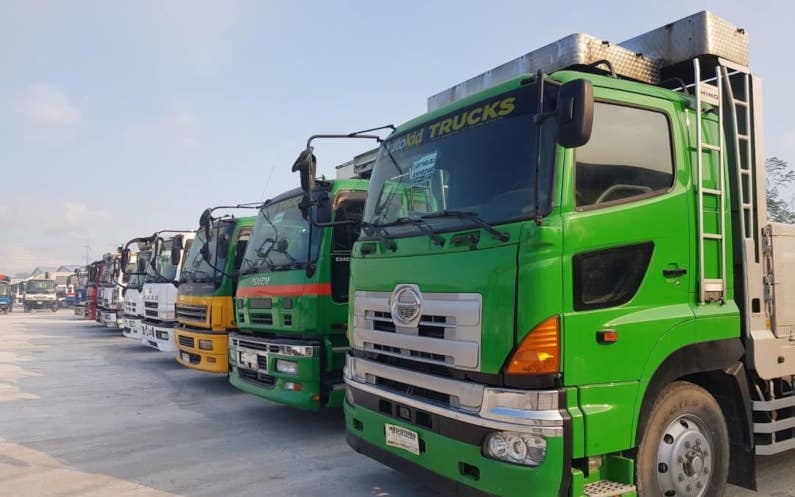
By Toda Namiki, Editor, Japanese Auto World
A trucking company that runs used Japanese trucks succeeds or fails on three things: buying trucks that can be kept running, maintaining them before they break, and holding on to drivers and customers when freight slows. Each is cheaper to get right early than to repair later.
Key facts
- Inspect the chassis and frame before the engine. A frame is harder and costlier to repair than an engine.
- Keep a service record for every truck. It shows which trucks are costing you the most.
- Count the cost of downtime when you decide whether to repair or replace a truck.
- Protect experienced drivers and dispatchers when freight slows. They are costly to replace.
What should you check before buying a used Japanese truck?
The purchase decides most of your maintenance costs for years, so inspect before you negotiate.
- Ask for the service history, and confirm the mileage or engine hours against the records.
- Inspect the chassis, frame and suspension for cracks, rust and welded repairs before you look at the engine.
- Check the transmission, clutch and differentials on a road test under load.
- Confirm that parts for that model can be sourced in your market, and how long they take to arrive.
- Budget for the first service, and for the parts most likely to need replacing soon after purchase.
A truck with a clean engine and a bad frame is a poor buy. A well-documented truck with a known history usually costs less to run than a cheaper one with gaps. For a fuller checklist, read the used truck buying points guide. If you are new to buying trucks, start with the first-time truck buyer guide. Popular makes have their own listings here too, including Hino used trucks from Japan and Isuzu used trucks from Japan.
A smaller fleet may suit a light-duty truck. Read why the Isuzu Elf sells so well around the world for its history and the points to check on a used one.
For the first purchase, read the used truck buying checklist. For the service plan that keeps a fleet running, see the used truck maintenance guide.
How do you keep a fleet of used trucks running?
Schedule inspections before breakdowns, not after them. A driver who walks the truck each morning, checks the fluids, tyres and lights, and reports one unusual noise saves a tow later in the week.
Keep a record for every truck: service dates, parts fitted, repair costs and recurring problems. The record shows which trucks are expensive to keep, and it tells you when repair has become a habit rather than a fix. The used truck maintenance guide sets out what to check at each service interval.
When should you repair a truck, and when should you replace it?
Repair when the frame is sound, the parts are available, and the truck still has a useful service life ahead of it. Replace when the same fault keeps returning, when the frame has been welded repeatedly, or when the truck spends more days in the workshop than on the road.
Count the cost of downtime as well as the repair bill. A truck that is off the road for a week loses the freight it was meant to carry, and sometimes the customer too.
How do you plan maintenance around the routes?
Plan services by mileage or engine hours, and fit them into gaps between routes rather than in the middle of a delivery. A long-haul truck due for a service should go in before the next long run, not after a failure on the road.
Keep a spare-parts list for each model in the fleet. Filters, belts, brake pads and the parts you replace most often should be on the shelf or quick to order. The quicker a part arrives, the shorter the truck stays off the road.
How should you manage drivers and staff?
Stay visible. Check the fleet in person and talk with drivers and dispatch. A manager who stays in the office with the door closed unsettles the team, and that is hard to recover from.
Protect the experienced drivers and dispatchers who know your trucks and your customers. Look at reduced hours before you cut jobs, because loyal staff are costly to replace. If cuts cannot be avoided, make them in one clear step and then move on. Cuts spread across many weeks keep people looking for other work.
Where should you cut costs, and where should you not?
Start with the costs that do not affect customers or safety: idle trucks, unused fuel cards, and repairs you can schedule for a cheaper time. Those savings are real and they do not hurt the business.
Be careful with customer service, driver training and sales coverage. These usually pay back over time. Cut them and the revenue loss arrives later, when the customers you lost are hard to win back.
How do you keep customers when freight is slow?
Reliability keeps customers. A carrier that arrives on time, answers the phone and tells the customer about a delay before the customer finds out keeps its contracts through a slow period. Share the plan for each route, and agree on the delivery windows in writing.
Review your customers each quarter. Know which ones bring the most freight, which ones pay on time, and which ones you could lose without much effect. Give the most attention to the customers who would be hardest to replace.
How do you protect cash when freight slows?
Keep cash reserves large enough to cover the period it takes to replace a lost contract. Decide the trigger points for action before a downturn starts: a fall in volume for a set number of weeks, a fall in margin, or a customer who stops paying. When a trigger is reached, act on the plan you wrote in good times.
Freight volumes move in cycles, and they do not always match the wider economy. Track your own volumes each month against your costs, and rely on your own numbers more than on headlines.
For used commercial vehicles of every kind, browse the commercial vehicles section.
Frequently asked questions
What should I check first when buying a used Japanese truck?
Start with the service history and the chassis. An engine can be rebuilt more easily than a damaged frame can be repaired.
How often should a used truck fleet be inspected?
Drivers should check each truck every day. Schedule a full mechanical inspection at the interval the manufacturer sets for that model.
Should I cut staff when freight slows?
Look at reduced hours first. If you must cut, do it in one step, and protect the experienced drivers and dispatchers you will need when volumes return.
When should I replace a truck instead of repairing it again?
Replace it when the same fault keeps returning, when the frame has been repeatedly welded, or when downtime costs more than the truck earns. A repair history that keeps growing is usually the clearest sign.
Is a used Japanese truck a good choice for a small trucking company?
It can be, if the truck has a documented history, parts are available for its model, and the company can keep up with maintenance. A cheap truck with no records often costs more to run than one that costs more to buy.